
How Digital Mirrors of the Real World Are Transforming the Way We Plan, Build, and Manage Urban Life
Cities today are no longer just physical spaces filled with buildings, roads, and utilities. They are dynamic ecosystems generating massive streams of data every second — from traffic signals and power grids to weather sensors and satellite imagery. As urban challenges grow more complex, so does the need for a smarter, more responsive way to understand, manage, and improve our cities.
This is where Digital Twins step in.
A digital twin is far more than a 3D model or a dashboard. It is a living mirror of the real world — a virtual city that sees what the physical city sees, learns from real-time data, simulates future scenarios, and helps planners, engineers, and citizens make better decisions. Whether it’s predicting floods, optimizing energy use, reducing traffic congestion, or improving infrastructure resilience, digital twins are rapidly becoming the backbone of modern urban innovation.
In this blog, we explore digital twins from the ground up — what they are, why they matter, how they evolved, and the technologies that make them possible. You’ll understand the complete workflow behind building a City-Scale Digital Twin, learn about the tools and platforms powering them (from ArcGIS CityEngine to Cesium, 3DCityDB, iTwin, and more), and dive into real urban use cases across planning, energy, disaster management, and mobility.
By the end of this guide, you’ll have a clear roadmap for starting your own digital twin project — from collecting datasets to integrating IoT feeds, building 3D models, running simulations, and deploying everything onto a unified interactive platform.
And this is just the beginning.
In the next blog, we will go hands-on with one of the most widely used open-source platforms for managing 3D city models — 3D City Database (3DCityDB). We will walk through the full beginner workflow, which includes installing the Importer/Exporter, setting up PostgreSQL and PostGIS, importing CityGML data, exporting 3D Tiles, integrating KML/COLLADA/glTF models, and visualizing them using the Cesium-based 3D Web Client. These practical exercises will help you actually build and visualize real city-scale digital twins step by step.
Welcome to the world of Digital Twins — where cities don’t just exist, they think, predict, and evolve.
Before we explore how digital twins are built and used today, it’s important to understand where the concept came from and how it evolved into the intelligent, real-time systems we see in modern cities.
A Digital Twin is a living digital model or a virtual copy of a real-world object, system, or process that is continuously updated with real-time data from sensors, devices, and other sources.
It acts like a mirror of the real world — showing how something is performing, how it’s likely to behave, and what can be improved — all inside a computer model.
It helps people monitor, analyze, and predict the performance of physical things — like cities, buildings, machines, or bridges — without being physically present.
Digital Twins may seem like a modern concept, but their roots go back more than 50 years. The idea started with engineering simulations and gradually evolved into today’s highly intelligent, real-time, AI-powered city-scale twins.
🔹 1960s–1970s — NASA’s Early Simulations
Engineers created physical duplicates and simulation models of spacecraft so they could troubleshoot and test changes without touching the real one.
🔹 2002 — First Formal Definition
Dr. Michael Grieves introduced the term “Digital Twin” in the context of Product Lifecycle Management (PLM).
🔹 2010–2015 — IoT Boom
Sensors became cheaper. Cloud computing became mainstream. Digital twins shifted from concept to practical use in manufacturing and aerospace.
🔹 2015–2020 — Rise of Smart Cities & Industry 4.0
Digital twins expanded into urban planning, utilities, mobility, energy, and environmental modeling.
🔹 2020–Present — AI-Driven Digital Twins
AI, real-time 3D visualization, and cloud streaming platforms (Cesium, Unity, Unreal, Omniverse) transformed digital twins into immersive, data-driven replicas of entire cities.
During the Apollo 13 mission, NASA faced a near-catastrophic explosion onboard the spacecraft. To save the astronauts, engineers on Earth used an exact replica — same hardware, same configuration — to simulate every possible scenario and test solutions safely before sending instructions back to the crew.
This replica wasn’t called a “digital twin” at the time, but it was the first real use of the concept:
a model of the real system that mirrors its condition, allows simulation, and helps solve problems remotely.
Today’s digital twins are far more advanced — powered by real-time data streams, satellite imagery, AI, 3D models, and cloud computing — but the philosophy remains the same:
“Understand the real world better by recreating it in a virtual space.”
With this historical foundation in place, the next step is understanding the different forms digital twins can take — especially how each type functions within a city ecosystem.
Digital Twins come in multiple levels depending on how detailed and complex the representation is. In the context of cities, each type plays a unique role — ranging from modeling individual components (like a traffic light) to replicating the entire city ecosystem (like Singapore’s Virtual Singapore project).
What it represents: A digital replica of a single physical part or component. Example: A smart streetlight with sensors measuring brightness, energy consumption, and pedestrian movement. Its digital twin monitors:
This helps municipal teams optimize street lighting and reduce power consumption.
What it represents: A digital model of an individual asset composed of multiple components. Example: A traffic signal system at a busy intersection. The digital twin includes:
The city can monitor peak traffic hours, predict congestion, and automatically adjust signal timings.
What it represents: A twin that models an entire process or workflow rather than just an object. Example: A waste collection process for a city neighborhood. The digital twin simulates:
Result: Improved efficiency, reduced fuel costs, and cleaner streets.
What it represents: A combined digital twin of multiple interconnected assets and processes. This is the level where an entire city digital twin emerges. Example: A full urban mobility digital twin that integrates:
This is the most comprehensive and intelligence-driven form of a digital twin.
Once we understand the different levels of twins, the natural question becomes: how do these diverse models stay consistent, compatible, and interoperable? This is where data standards become absolutely essential.
Data standards are the backbone of any successful digital twin. Without common formats, a city’s datasets — GIS layers, BIM models, traffic sensors, IoT feeds, LiDAR point clouds — sit in silos, unable to talk to each other. Standards ensure that 3D models, attributes, and sensor data can be shared, integrated, and visualized consistently across software platforms like Cesium, Autodesk, ArcGIS, and Bentley iTwin.
Here’s why standards are essential:
Below are the major standards used in city digital twins:
A standardized data model for representing 3D city objects — buildings, terrain, vegetation, water bodies, transportation networks.
An open BIM standard used for storing detailed building and infrastructure models.
Example: A city integrates IFC models of new metro stations into its 3D city twin to analyze passenger flow and emergency evacuation scenarios.
BIM is not a file format — it’s a methodology. BIM models (IFC, RVT, etc.) represent building-level twins, describing:
Example: In a smart campus, BIM twins of buildings connect to IoT sensors for real-time air quality and energy optimization.
A modern, open standard for streaming massive 3D geospatial datasets on the web.
Example: A city exports its entire 3D model to 3D Tiles to visualize traffic, IoT sensors, and construction updates in a browser-based digital twin dashboard.
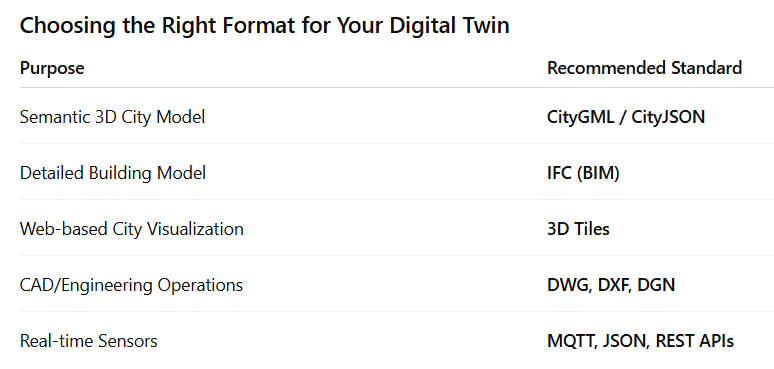
Standards form the language of a digital twin — but building one requires far more than formats. To turn data into a living, urban-scale digital model, we need to understand its core technological components.
A successful city digital twin is not built from a single technology — it is an ecosystem of integrated components working together to represent, monitor, simulate, and improve the real city.
A city-scale digital twin is built on a collection of deeply interconnected technologies that work together to create a living, breathing model of an urban environment. At its foundation is Geographic Information Systems (GIS), which provides the spatial context — maps, parcels, roads, utilities, terrain models — that form the backbone of a city twin. GIS ensures that every object, from a lamp post to a 50-storey building, is placed accurately in geographic space. Complementing GIS is Remote Sensing, which supplies high-resolution satellite imagery, LiDAR scans, drone photogrammetry, and thermal or hyperspectral imagery to build precise 3D models and detect real-world changes over time. These datasets allow the twin to stay updated with ground truth.
The next critical layer is IoT and sensor networks. Without real-time data, a digital twin is only a static 3D model. IoT feeds the twin with live streams of traffic counts, energy use, air quality levels, water pressure, weather conditions and more — turning the model into a dynamic “digital mirror” of the city. To make sense of this incoming data, cities depend on AI and Machine Learning, which perform demand forecasting, anomaly detection, behavioural predictions, and environmental simulations. In modern digital twins, AI is also used for automated change detection from satellite/drone imagery, and increasingly, Generative AI helps automate 3D modeling, scenario exploration, and conversational interactions with the twin.
Simulations form another indispensable component. Simulation engines such as traffic models, flood models, agent-based models, or energy simulations allow planners to test “what-if” scenarios before implementing solutions in the real world. These simulations are powered by Cloud Infrastructure, where massive datasets are stored, processed, and streamed. Cloud platforms enable scalability, high-performance computing, and complex analytics that city-scale digital twins require.
To bring everything to life visually, city twins rely on a 3D/Visualization Engine — often Cesium, Unreal Engine, Unity, Autodesk tools, or Esri’s CityEngine. These engines render 3D tiles, BIM objects, terrain, textures, lighting and real-time animations, making the twin intuitive and immersive. Today, cities are also starting to integrate AR and VR, allowing planners to walk inside a digital building, inspect underground utilities, or visualize future city plans in mixed reality environments.
Finally, several emerging technologies are enhancing trust, security and efficiency. Blockchain is being explored to guarantee data integrity, audit sensor inputs, or track infrastructure lifecycle events. Edge Computing supports faster processing by handling sensor data directly at the source — reducing latency for applications like traffic signal optimisation or emergency response. Together, these technologies form the core building blocks of a modern city digital twin, transforming raw data into an intelligent, interactive, and continually evolving model of urban life.
These technologies work together, but they need a clear structural blueprint. To see how everything connects behind the scenes, we now look at the architecture that powers a digital twin.
A digital twin may look like a single unified model from the outside, but behind the scenes, it is built on a layered, interconnected architecture that brings together data, computation, and visualization into one living system. At its core, a digital twin integrates three worlds: the physical environment, the digital representation, and the data exchange layer that keeps them synchronized.

The first layer is the physical environment, the real-world system being mirrored. In the case of a city digital twin, this includes buildings, roads, utilities, mobility networks, landscapes, sensors, and anything that generates data. This physical layer constantly produces raw inputs — from IoT sensors, satellites, drones, LiDAR scanners, CCTV feeds, weather stations, traffic counters, smart meters, or even citizen-generated data.
The second layer is the data ingestion and integration layer, which captures this real-world information and funnels it into the digital twin. This is where data pipelines, ETL workflows, and streaming protocols operate. Technologies such as MQTT, REST APIs, cloud IoT hubs, geospatial servers, and remote sensing workflows transform all incoming information into structured datasets. At this stage, accepted standards like CityGML, IFC, BIM, GeoJSON, 3D Tiles, LandUse codes, and metadata specifications are crucial — they ensure that diverse datasets can speak the same language and fit into a unified model.
Once the data is ingested, the third layer — data management and storage — organizes it into an accessible, scalable system. This layer typically includes geospatial databases (PostGIS, 3DCityDB), BIM repositories, time-series databases for sensor feeds, cloud object storage for large imagery or point clouds, and metadata registries. This is the “memory” of the twin, holding everything from historical data and 3D models to IoT time-series streams and simulation inputs.
Above this sits the modeling and analytics layer, where intelligence happens. Here, simulation engines, AI/ML models, physics-based solvers, and geospatial analytics process the data to make predictions, generate alerts, and test scenarios. Whether it’s predicting flooding in a low-lying neighborhood, estimating building energy usage, simulating traffic routing, or detecting structural stress in a bridge, this analytical layer gives the digital twin its predictive and prescriptive capabilities. It also connects with domain-specific engines such as energy simulators, hydrologic models, finite element analysis tools, or agent-based mobility models.
The next layer is the 3D representation and visualization engine, where all information becomes interactive. Tools such as Cesium, Unreal Engine, Unity, CityEngine, or custom WebGL/WebGPU engines render the city in 3D. This is where maps, buildings, vegetation, infrastructure networks, and live sensor feeds are unified into a visually intuitive experience. For users, this is the face of the digital twin — an interactive environment where they can explore, query, and understand the system in real time.
Finally, the top layer is the user interaction and application layer, consisting of dashboards, analytics interfaces, APIs, mobile apps, decision-support tools, and command-center views. This layer shapes how planners, engineers, citizens, policymakers, and emergency responders interact with the digital twin. Whether it’s a real-time air quality map, a construction monitoring dashboard, or a predictive flood simulation panel, this application layer connects insights to action.
Together, these layers form the architectural backbone of a digital twin — continuously sensing, thinking, and visualizing. It is this architecture that transforms raw, chaotic data from the physical world into a dynamic, intelligent system capable of guiding decisions, optimizing operations, and predicting the future of a city.
Understanding the architecture makes it easier to appreciate what digital twins can actually do. With the foundations in place, we can now explore the real-world benefits they bring to cities and industries.
A digital twin allows continuous, real-time monitoring of physical assets, systems, or environments. Sensors and IoT devices collect live data — such as temperature, energy use, or air quality — and feed it into the digital model. This helps city planners, engineers, or operators observe what’s happening at any given moment. Example: In a smart city, digital twins track traffic flow and air pollution levels in real time, allowing authorities to respond quickly to congestion or poor air quality.
By analyzing patterns in live and historical data, digital twins can predict when equipment or infrastructure might fail. This means maintenance can be done before problems occur, reducing costly downtime and repairs. Example: In a smart building, sensors on HVAC systems send performance data to a digital twin that predicts when a unit will need servicing, preventing system breakdowns.
Digital twins make it possible to simulate “what-if” scenarios without experimenting in the real world. Planners and engineers can test how a change — like new construction, traffic rerouting, or extreme weather — would affect the system. Example: Urban planners can use a city’s digital twin to simulate heavy rainfall and identify flood-prone areas before a storm occurs.
Because digital twins combine real-world data with predictive models, they provide decision-makers with deep insights for smarter planning and resource allocation. Decisions become data-driven rather than assumption-based. Example: Utility managers can use a water network’s digital twin to identify pressure issues, plan pipe replacements, and optimize water distribution efficiency.
A digital twin helps reduce costs and save time by detecting inefficiencies early and minimizing trial-and-error in design or operations. Since simulations replace physical testing, resources are conserved.
Example: Construction teams use digital twins of buildings to detect design flaws virtually before actual construction begins, avoiding expensive rework later.
Engineers and designers use digital twins to test and refine designs continuously using real-world feedback. As data accumulates, models evolve, leading to innovation and performance improvement over time.
Example: Automotive companies like Tesla use digital twins to analyze how cars perform in real-world driving and improve future vehicle models.
Digital twins provide interactive 3D visualization of complex systems, helping teams from different departments understand and collaborate easily. They serve as a single source of truth where everyone can see the same data and models. Example: City planners, utility managers, and architects can all view the same 3D digital twin of a city, enabling coordinated decisions about roadworks, zoning, and public utilities.
By continuously tracking energy use and environmental conditions, digital twins help optimize resource consumption and promote sustainability. They identify wasteful patterns and suggest more efficient alternatives. Example: In smart campuses, building twins automatically adjust lighting and air conditioning based on occupancy, saving energy and reducing carbon emissions.
Digital twins support risk analysis and emergency planning by simulating natural disasters, accidents, or system failures. They help authorities design safer, more resilient systems.
Example: Flood-prone cities like Singapore and Rotterdam use digital twins to simulate water flow and plan better drainage and evacuation strategies.
Digital twins represent assets throughout their entire lifecycle — from design and construction to operation, maintenance, and eventual decommissioning. This continuous data connection ensures better asset health and long-term performance.
Example: Infrastructure managers maintain a digital twin of bridges or tunnels to track structural changes, enabling safe operation and efficient maintenance over decades.
Knowing what digital twins can achieve, the next question is: how do we actually build one? Let’s walk through the complete end-to-end workflow of creating a city-scale digital twin.

Building a city-scale digital twin is not a single action but a multi-layered process that brings together data engineering, 3D modelling, IoT integration, and simulation technologies. The workflow typically begins with defining the purpose of the twin — whether the goal is urban planning, disaster resilience, energy optimisation, traffic management, or simply centralised monitoring. Without a clear objective, the twin easily becomes an expensive 3D model with no real intelligence. So the first step is always framing the vision: What will the digital twin solve? Who will use it? What data is required?
Once the goals are defined, cities move into the data-collection phase. This involves gathering geospatial information such as cadastral maps, land-use layers, road networks, utility lines, and administrative boundaries. Remote sensing data — satellite imagery, aerial photography, and LiDAR scans — help reconstruct the physical form of the city. BIM models contribute interior details for complex buildings, while IoT sensors provide real-time updates on traffic, air quality, water distribution, energy consumption, and environmental conditions. At this point, the city is essentially collecting its “digital DNA.”
The next step involves integrating and harmonising these datasets. Cities rarely store information in one place, which means incoming data arrives in multiple formats — CityGML, IFC, Shapefiles, GeoJSON, CSV, 3D Tiles, and even scanned PDFs. This stage demands strong GIS workflows, data cleaning, projection alignment, and establishing a unified spatial reference system. The goal is to make everything interoperable so that the digital twin becomes a living ecosystem rather than a fragmented collection of files.
Once the data foundation is set, the 3D city model begins to take shape. Tools like CityEngine, ArcGIS Urban, FME, Blender, or 3D Tiles pipelines are used to reconstruct buildings, terrain, vegetation, utility networks, and public spaces. Some cities adopt Level of Detail (LOD) modelling, where simple extruded footprints represent large areas, while high-detail photogrammetry or BIM enrich priority locations. At this stage, the digital twin becomes visually explorable — forming a spatial canvas on which intelligence will be layered.
Real-time integration is what transforms a 3D model into an actual digital twin. IoT devices, traffic sensors, environmental monitors, energy meters, CCTV feeds, and weather stations constantly push new information into the system. Cloud platforms, APIs, MQTT streams, and data brokers ensure that the virtual city remains synchronised with the physical one. Every piece of data, from the water level in a canal to the movement of a bus, becomes a living input feeding the twin.
After integrating live data, cities add intelligence through analytics, AI models, and simulations. This is where digital twins become powerful decision-making tools. Machine learning predicts traffic congestion, flooding, infrastructure stress, or energy consumption. Simulation engines help run what-if experiments — How will a new flyover affect congestion? What happens if rainfall increases by 20%? Where should emergency responders be positioned during a major event? At this stage, the digital twin is no longer just a model — it becomes a predictive and prescriptive system.
The final layer involves building visualisation interfaces and interactive dashboards. These may take the form of 3D web platforms, immersive AR/VR environments, or city command-and-control dashboards. Planners, policymakers, researchers, and citizens can view the city from multiple perspectives, explore data layers, run scenarios, and make informed decisions. Accessibility and user experience become just as important as technical accuracy.
A city digital twin is never “finished.” It must evolve continuously — updated with new satellite imagery, revised zoning maps, IoT data, construction progress, policy changes, and environmental observations. Governance frameworks ensure data quality, security, and privacy as the system scales. Over time, the twin becomes a long-term digital infrastructure asset, supporting everything from climate resilience to mobility planning and sustainable development.
Below is a curated list of powerful tools and platforms used worldwide to create, manage, simulate, and visualize 3D city-scale digital twins.
A procedural 3D city-modeling tool by Esri, ideal for generating large-scale urban models from GIS footprints, terrain, and rule-based design.
Procedural City Generator | 3D City Maker | ArcGIS CityEngine
An open-source PostgreSQL/PostGIS database designed to store and manage semantic 3D city models (CityGML). A strong foundation for digital twin back-ends.
A high-performance 3D geospatial engine (WebGL/WebGPU) for streaming buildings, terrain, and real-time sensor data — widely used for interactive city twins.
Cesium: The Platform for 3D Geospatial
Microsoft’s cloud platform for modeling digital replicas of buildings, campuses, and cities, with IoT integration and real-time data relationships.
https://azure.microsoft.com/en-us/products/digital-twins/
Infrastructure-focused digital twin solution supporting lifecycle management of bridges, roads, utilities, and city infrastructure.
Digital Twins | Infrastructure Digital Twin Software
An urban digital twin tool for creating, managing, and sharing 3D city dashboards, planning scenarios, and decision-making workflows.
Revolutionizing Urban Digital Twins with Open Source Technology
A detailed, photorealistic 3D digital twin of major cities used for planning, visualization, and stakeholder engagement.
VU.CITY | Visualise, Model and Understand Urban Change in 3D
Autodesk’s digital twin platform integrating BIM and GIS data for building lifecycle management and facilities operations.
Digital Twin Technology & Software | Autodesk
An open-source WebGL SDK for visualizing massive BIM and 3D city models directly in browsers, suitable for custom twin applications.
Build Faster 3D Web Apps for BIM | Open-Source xeokit SDK
Combines 2D/3D GIS, CAD, BIM, and asset data into a unified environment for building digital twins of complex city-scale systems.
An open-source smart city digital twin ecosystem that supports IoT integration, 3D visualization, analytics, and what-if simulations.
A browser-based 3D city planning tool allowing GIS data import, scenario testing, and digital twin visualization.
Hexagon’s platform for combining reality capture, 3D mesh models, sensor feeds, and analytics into a unified urban twin.
https://hexagon.com/solutions/digital-twin/
A simulation-driven platform used for infrastructure and energy assets; relevant for city infrastructure components.
Akselos - Structural Performance Management Software
AnyLogic is a powerful tool for creating and integrating a digital twin.
Digital Twin Development and Deployment
A powerful simulation environment used for system-level modelling within digital twin workflows — mostly for engineering assets.
Dassault’s large-scale city digital twin framework, famously used for Virtual Singapore.
An open-source IoT platform developed by Barcelona City for sensor management — useful as a real-time data layer in digital twins.
A cloud-based IIoT and analytics platform that supports digital twin applications for infrastructure and urban systems.
Insights Hub industrial IoT | Siemens Software
A leading spatial ETL platform widely used for integrating GIS, BIM, CAD, and 3D models into digital twin datasets.
Platform - FME by Safe Software
A powerful mapping and location-data platform offering real-time, scalable 2D/3D maps, terrain, 3D buildings, custom data layers, and analytics — widely used to build interactive city-scale visualisations (including digital twin style applications).
https://www.mapbox.com/mapbox-gljs
A digital twin and operations management platform by AVEVA, integrating engineering, real-time data, and analytics for asset-intensive industries.
A real-time 3D simulation and collaboration platform by NVIDIA, used for high-fidelity virtual twins, immersive environments, and multi-user workflows.
An IoT-enabled digital twin platform aimed at asset monitoring, analytics, and predictive maintenance in industrial settings.
ThingWorx: Industrial IoT Software | IIoT Platform | PTC
A platform specialising in point-cloud and reality capture integration with digital twins, useful for built-environment and city-scale models.
Cintoo - Digital Twin Platform & Reality Capture Software
A cloud streaming platform for high-fidelity digital twin applications built in Unreal Engine, Unity, or custom 3D tools; enables browser-based access to complex twin models.
Scalable Pixel Streaming & Application Streaming Solution
A construction-site visualization and monitoring tool integrating camera feeds, BIM data and time-lapse analytics; while narrower in scope, it supports digital twin workflows for built infrastructure.
Home - Construction Visibility | Evercam
A 3D digital-twin and AI analytics platform used by utilities to simulate power grid or vegetation risks and support infrastructure decision-making
undergrounding and grid hardening Archives | Neara
A service by Amazon Web Services that enables you to build digital twins of real-world systems by integrating data from sensors, video, and enterprise applications.
Digital Twin IoT - AWS IoT TwinMaker - AWS
A simulation-first platform that allows creation of high-fidelity virtual prototypes and full lifecycle digital twins for systems and assets.
Digital Twin Simulation-Based Software | Ansys
Creating a city-scale digital twin is as much a technological effort as it is an organizational one. While the idea of a fully connected, real-time virtual city is compelling, the path to building it is filled with practical, architectural, and governance-related challenges that cities must actively navigate.

1. Data Interoperability and Fragmentation
Cities generate data in dozens of formats — GIS layers, satellite imagery, BIM models, IoT streams, utility datasets, and legacy municipal records. These come from different departments, different vendors, and different standards, making them hard to merge into a unified digital environment. For example, a building’s 3D model may be available in IFC, zoning boundaries in shapefiles, underground utilities in CAD, and IoT sensor feeds in JSON — none of which naturally talk to each other. Harmonizing these formats into a consistent spatial data standard (CityGML, 3D Tiles, IFC) becomes one of the most time-consuming tasks in any digital twin project.
2. Scaling to City-Level Complexity
Modeling a few buildings is easy; representing an entire city with millions of objects, live sensors, and high-resolution terrain is exponentially harder. Large urban twins need massive computing power, high-performance storage, and streaming-optimized formats like 3D Tiles to remain responsive. Without architectural optimization, even simple tasks — like zooming into a neighborhood or querying a building’s attributes — can become slow or unstable. The scale of a real city demands careful planning around how data is tiled, indexed, streamed, and rendered.
3. Real-Time Data Ingestion and Reliability
A digital twin becomes truly useful only when it reflects what’s happening in the physical city right now. This requires stable, continuous ingestion of real-time data from traffic sensors, smart meters, weather stations, cameras, and IoT networks. In practice, many sensors fail, send inconsistent data, or operate on different time intervals. Ensuring data quality, handling missing values, and maintaining uptime are major engineering challenges. A city may have thousands of sensors, each generating noise, drift, or outliers that need to be filtered before entering the twin.
4. Governance, Ownership & Institutional Coordination
Digital twins sit at the intersection of multiple city departments — planning, utilities, transport, environment, disaster management. Each may hold its own datasets, access rules, and internal processes. Building a unified digital twin requires breaking departmental silos, establishing data-sharing agreements, and defining who owns what. Without strong governance, a digital twin risks becoming a patchwork of partial datasets rather than a single, authoritative system.
5. Privacy, Security, and Ethical Concerns
As cities integrate more real-time sensors — traffic cameras, mobility data, environmental monitors — questions around privacy become unavoidable. A digital twin that models people’s movement patterns, energy usage, or daily routines must ensure that sensitive data is anonymized and securely stored. Cybersecurity becomes critical too: a compromised digital twin could lead to manipulation of real infrastructure or public misinformation. Balancing openness with safety requires well-defined policies and robust security architecture.
6. Cost, Skills, and Long-Term Maintenance
Digital twins are not one-time projects; they are living systems that evolve alongside the city. Maintaining them requires skilled teams across GIS, IoT, cloud architecture, simulation, and cybersecurity — talent that is often scarce in municipal organizations. Additionally, the upfront investment in cloud infrastructure, license fees, sensors, and staffing can be substantial. Cities must plan not just for building the twin, but for sustaining it over years.
7. Keeping the Twin Updated with Physical-World Changes
Cities evolve constantly: new buildings appear, roads change, green spaces shift, and utility networks expand. If the digital twin does not reflect these changes, it quickly becomes outdated. Automating updates — using drone imagery, LiDAR scans, or satellite-based change detection — is essential but technically challenging. The goal is to create a twin that remains synchronized with the physical world without requiring manual updates for every modification.
To overcome these hurdles, cities around the world follow a set of proven strategies. These best practices ensure that digital twin projects remain scalable, accurate, and future-ready.

Building a city-scale digital twin is not just a technical exercise — it is a long-term strategic investment that requires coordination across data, technology, and people. Successful projects around the world share a set of disciplined practices that ensure the digital twin remains accurate, scalable, and truly useful to decision-makers. One of the most important principles is establishing strong data governance from the beginning. Cities typically collect data from dozens of departments — transportation, utilities, planning, environment — and without clearly defined standards, access rules, and update cycles, the digital twin quickly becomes outdated or fragmented. Having a central governance framework ensures that all stakeholders follow consistent formats, metadata rules, and data-sharing policies.
Equally critical is interoperability, especially for city-scale models where GIS, BIM, remote sensing, IoT feeds, and simulation engines must work together. Using open standards such as CityGML, IFC, GeoJSON, and 3D Tiles prevents vendor lock-in and allows the twin to integrate new datasets over time. Cities that rely on proprietary formats often struggle to expand their digital twins beyond pilot zones.
A successful digital twin must also be scalable, both technically and operationally. As a city grows and deploys more IoT systems, datasets can expand from gigabytes to terabytes. Cloud-native architectures — such as AWS TwinMaker, Azure Digital Twins, or Cesium for 3D Tiles streaming — ensure that the system can handle higher resolution models, more real-time feeds, and more users without performance bottlenecks. Scalability also includes planning for future use cases: the twin should support not only today’s visualization needs but also tomorrow’s AI-driven simulations, predictive analytics, and automated decision systems.
Another key factor is continuous stakeholder involvement. Digital twins often fail because they are built by a single department without consulting others who could benefit from the system. In contrast, successful cities treat the digital twin as a shared public infrastructure — co-designed with planners, transport authorities, disaster-management teams, environmental agencies, and even citizens. Regular workshops and feedback loops ensure the digital twin addresses real operational pain points, not just technical aspirations.
In addition, cities should invest in real-time data pipelines, enabling the digital twin to reflect the living city rather than a static snapshot. Automated ingestion from IoT devices, satellite imagery, and sensor networks keeps the twin relevant and actionable. Pairing this with AI and ML — such as anomaly detection, predictive maintenance, or demand forecasting — unlocks the twin’s true value as a decision-support intelligence system.
Finally, long-term success depends on sustainable operations and maintenance. A digital twin is not a one-time project but an evolving ecosystem. Establishing dedicated teams, securing multi-year funding, and adopting policies for periodic updates ensures the twin remains accurate and trustworthy. Cities that treat digital twins as living infrastructure rather than IT projects consistently see higher return on investment and stronger real-world impact.
These principles lay the foundation for long-term success. To see their impact, let’s explore how digital twins are being applied across different sectors and what they enable in practice.
Digital twins are no longer limited to engineering or manufacturing — they now power some of the most advanced systems across cities, buildings, utilities, transportation networks, and environmental management. Their strength lies in unifying real-time data, spatial intelligence, and simulation models into a single living digital environment. Below is a clear, narrative explanation of how different sectors apply digital twins, illustrated with city-focused use cases.
Smart Cities & Urban Governance
Cities use digital twins to understand how different systems — traffic, utilities, zoning, and the environment — interact with each other. A digital twin acts as a real-time mirror of the urban landscape, allowing planners to simulate future scenarios, test policy decisions, and visualize infrastructure before building anything physically. For example, a city government may use its digital twin to simulate a new metro line, assess its environmental impact, or optimize traffic flows around construction zones. Officials gain a data-backed way to evaluate decisions that traditionally depended on intuition or manual surveys.
Buildings & Facilities Management
In the built environment, digital twins are increasingly used to manage energy consumption, track occupancy, improve safety, and optimize maintenance. These building twins are powered by IoT devices such as smart meters, occupancy sensors, and HVAC controls. A commercial tower can maintain a digital twin that tracks temperature gradients, elevator movement, and air quality, helping facility managers identify inefficiencies or detect equipment failures before they occur. Large campuses and hospitals often integrate BIM models with real-time building systems, creating a single source of truth for maintenance teams and architects.
Energy Grids & Utilities
Digital twins play a transformative role in the operation of power grids, water networks, and gas pipelines — systems that require constant monitoring and rapid response. Utility providers use them to detect risks such as load imbalances, pipe pressure anomalies, or leakages. For instance, a city’s water utility can maintain a digital twin of its pipe network; by combining pressure sensor data with hydraulic models, it can predict where a leak may occur or how to reroute flow during maintenance. Renewable energy plants also use digital twins to balance solar or wind generation with consumption patterns.
Water Management & Environmental Monitoring
Cities vulnerable to climate risks rely heavily on digital twins to prepare for extreme weather. Hydrological models integrated with rainfall sensors, satellite imagery, and land-use data enable cities to predict flooding, understand storm-water behavior, and plan drainage upgrades. A coastal city can simulate how rising tides or severe storms might affect neighborhoods, offering authorities an invaluable tool for risk reduction. These models also assist in monitoring river systems, wetlands, and groundwater resources, ensuring ecological resilience.
Transportation, Mobility & Logistics
Digital twins help optimize mobility systems — buses, metros, road networks, and emerging autonomous transport. By combining GPS feeds, traffic cameras, and historical movement data, transport agencies can simulate congestion or test new mobility routes. A digital twin of an airport, for example, can model baggage handling, flight delays, and passenger circulation to improve operational efficiency. Cities often integrate traffic signals, ride-sharing demand, and parking patterns into their mobility twin to support real-time adjustments.
Healthcare & Public Safety
Although less visible, digital twins are increasingly used in urban healthcare infrastructure. They support hospital capacity forecasting, emergency response routing, and outbreak modeling. During a public health emergency, a city may use a digital twin to track ambulance movement, monitor hospital bed availability, and simulate how a virus could spread in high-density neighborhoods.
While these applications are powerful, building a digital twin of this scale requires significant investment in technology, skills, and infrastructure. Let’s break down what it takes.
Building a full-scale digital twin — especially at the level of a city, utility network, smart campus, or industrial plant — requires a thoughtful blend of investment, skilled talent, hardware/software infrastructure, and long-term operational planning. While the exact budget varies across geographies and project scopes, most digital twin initiatives share similar cost categories and team needs.

Creating a digital twin is not just a software task. It is an ecosystem effort involving data collection, modelling, integration, simulation, and continuous maintenance. Costs typically start with geospatial data acquisition — such as drone surveys, LiDAR scanning, photogrammetry, or purchasing high-resolution satellite products. These can range from relatively affordable (for small sites) to significantly expensive for large, city-scale areas. The next major cost layer is cloud infrastructure: storing terabytes of imagery, point clouds, BIM models, and 3D scenes requires scalable cloud storage, GPU compute for rendering, and pipelines for real-time analytics, all of which incur monthly operational charges.
Team skills form another crucial investment. A successful digital twin usually needs a combination of GIS analysts, remote sensing specialists, BIM/3D modellers, data engineers, simulation experts, and sometimes AI/ML developers for predictive analytics. Depending on the complexity, additional roles such as IoT engineers, software developers, DevOps professionals, or visualization specialists (Unity, Unreal, Cesium, WebGL) come into play. These skill sets are often hard to find in a single team, making cross-department collaboration or outsourcing common.
Hardware and software licensing also influence the budget — whether using proprietary platforms (ArcGIS, CityEngine, iTwin, Hexagon, Autodesk) or open-source stacks (3DCityDB, CesiumJS, QGIS, PostgreSQL/PostGIS). Even open-source solutions require compute power, skilled staff, and maintenance budgets.
Finally, digital twins require continuous updating. Data pipelines, IoT sensors, real-time APIs, and periodic drone or satellite updates all come with recurring costs. Governance frameworks — covering data quality, versioning, privacy, and access control — must also be sustained over time.
Given the level of investment and complexity involved, aligning with global standards becomes essential. These standards ensure long-term interoperability, security, and trust in your digital twin ecosystem.
Standards are the backbone of any reliable digital twin. Without them, cities struggle with interoperability, data quality, and long-term maintainability. Digital twins depend on data coming from many sources — GIS, BIM, IoT, remote sensing, utility systems, and more. Industry standards ensure that all these systems speak the same language and can coexist over decades without breaking.
This standard defines a shared vocabulary for smart cities. It ensures all departments (transport, water, health, planning) describe data in a unified way — critical when integrating into a city's digital twin.
Though manufacturing-focused, its guidelines for creating dynamic data-driven twins — lifecycle modeling, feedback loops, contextualization — apply strongly to city digital twins as well. Cities increasingly adopt ISO 23247 to structure process-level twins such as traffic flow, water distribution, or energy balancing.
OGC standards bring interoperability to geospatial and 3D city twins.
Important ones include:
Adopting OGC formats ensures that GIS, BIM, IoT and 3D visualization systems integrate seamlessly.
An open standard for BIM models, essential for integrating detailed building data into a city twin.
Important when linking citizen data, CCTV feeds, or mobility datasets.
These standards establish trust, reduce vendor lock-in, and ensure long-term sustainability of your digital twin project.
Standards stabilize today’s twins, but the future will transform them even further. Emerging technologies are pushing digital twins beyond monitoring into fully autonomous, self-optimizing systems.
In the future, digital twins will not only monitor cities — they will make decisions. AI-driven twins will autonomously adjust traffic lights, balance energy loads, or detect and report infrastructure faults before humans intervene.
Instead of static simulations, AI agents will behave like citizens — planning travel, reacting to weather, adjusting consumption patterns. This helps cities test policies (congestion pricing, zoning reforms, public transport changes) with near-real accuracy.
As cities grow, simulating millions of interactions (traffic, utilities, population movement) becomes computationally heavy. Quantum simulation will enable ultra-fast scenario modeling — microclimate prediction, evacuation simulations, pollutant dispersion, etc.
Digital twins will merge with immersive metaverse environments:
Future digital twins will control physical robots and drones:
These robots will update the twin in real time, closing the virtual–physical loop.
Continuous data from hyperspectral satellites, drone fleets, and ground sensors will produce “living environmental twins” for rivers, coasts, forests, and climate systems — crucial for resilience planning.
A Beginner’s Roadmap to Building a Digital Twin
These trends outline where digital twins are headed. But how do you get started today? Let’s break down a simple, actionable roadmap for building your first digital twin.
Starting a digital twin project may seem overwhelming because it sits at the intersection of GIS, IoT, AI, remote sensing, and 3D visualization. But the process becomes manageable if approached systematically. A successful digital twin begins with a clear purpose, continues with structured data collection, and comes alive only after the right platform brings all data layers together.

The first step is to define a very specific use-case. Instead of aiming to “build a city digital twin,” define a narrow problem such as traffic congestion monitoring, flood-risk simulation for a ward, or smart building energy optimization. This clarity ensures that you collect only the essential datasets and avoid unnecessary complexity.
Once the objective is fixed, the next phase is data acquisition. Real digital twins rely on multiple data sources, and it is crucial to know where each dataset comes from. Spatial base layers such as roads, land parcels, zoning maps, and building footprints can be downloaded from OpenStreetMap, city open-data portals, municipal GIS departments, or national geospatial agencies. Terrain and elevation data often come from remote sensing sources like NASA SRTM, Copernicus DEM, or state LiDAR missions. For 3D city models or BIM representations, you can use LiDAR scans, drone photogrammetry, or request IFC/BIM files from architects. Real-time IoT data such as traffic counts, air quality, temperature, or water levels may be provided by municipal smart-pole networks, environmental agencies, or private IoT platforms. Socioeconomic, census, and utility datasets are generally available via e-governance portals, statistical departments, and utility boards.
After obtaining these datasets, the next challenge is integration. All layers must be aligned into a unified coordinate system and cleaned for consistency. GIS software like ArcGIS Pro or QGIS is used to standardize formats (GeoJSON, SHP, IFC, CityGML), repair geometry errors, merge overlapping layers, and build a coherent spatial database. This step also includes converting raw LiDAR or drone data into usable 3D formats such as LAS, 3D Mesh, CityGML, or 3D Tiles. For cities aiming for semantic, standards-driven twins, 3DCityDB is often used as the central CityGML database.
This brings us to a key question: where do all these datasets finally come together? In a digital twin, data integration happens in two layers — the backend and the visualization frontend. The backend is typically a spatial database (PostgreSQL/PostGIS, 3DCityDB, GeoServer) that stores and serves GIS and 3D models. Real-time IoT data flows into cloud platforms like Azure Digital Twins, AWS IoT TwinMaker, or MQTT brokers. Analytics and AI models are often deployed using Python, TensorFlow, or cloud pipelines.
The merging point — the place where everything becomes one coherent digital twin — occurs at the visualization layer. Platforms such as CesiumJS, ArcGIS Urban, NVIDIA Omniverse, or Bentley iTwin allow you to load GIS layers, 3D tiles, BIM models, IoT feeds, and analytics dashboards onto the same map. This unified interface is where the city becomes “alive”: traffic sensors blink in real time, buildings display energy consumption, drones generate new mesh updates, and simulations such as flooding or pedestrian flow appear as animated overlays.
With integration complete, the next step is bringing intelligence into the twin. This involves connecting analytics engines that can predict events like equipment failures, flood pathways, peak loads on transformers, or mobility bottlenecks. Here, machine learning models or rule-based simulations run in the backend and push results to the visualization layer.
Finally, deployment and continuous updates complete the lifecycle. Digital twins are not one-time models; they evolve continuously as new satellite images, IoT readings, construction updates, or demographic changes come in. Automated pipelines, cloud cron jobs, API connectors, and change-detection algorithms ensure that the twin remains synchronized with the real world.
By following this structured roadmap — clear objectives, reliable data sources, disciplined integration, an intelligent analytics layer, and a unified digital twin platform — even a beginner can build a powerful, scalable digital twin system.
A digital twin is not built in one day — it is built in layers. Start small, add data over time, integrate sensors gradually, and expand as your needs grow. Even a basic model with 3–4 datasets can become a powerful tool once connected to real-time information and analytics.
Digital twins are no longer futuristic concepts reserved for billion-dollar industries. They have become essential tools for cities, governments, and organizations seeking to understand their environments, make smarter decisions, and prepare for a rapidly changing world. From real-time traffic intelligence to climate-resilient urban design, from energy-efficient buildings to AI-driven emergency response — digital twins are reshaping how we plan, build, and operate the spaces we live in.
What makes digital twins transformative is not just the technology but the connectivity: GIS, IoT, AI, remote sensing, simulation engines, and cloud ecosystems working together as one living system. This fusion creates a powerful feedback loop between the physical and digital worlds, allowing us to simulate the future before we invest in it.
As technology evolves — with AI agents, autonomous city systems, robotics integration, and quantum computing — we are moving toward cities that can virtually “think,” “predict,” and “self-optimize.” The cities of tomorrow will not just be smart — they will be alive, constantly learning from themselves through their digital counterparts.
Whether you’re a student, researcher, policymaker, engineer, or just a curious urban enthusiast, this is the right moment to explore digital twins. Start small, pick one use case, build your data foundation, and grow steadily. The opportunities are immense — and the future is being designed right now.
I’d love to hear from you:
✨ What part of the digital twin ecosystem excites you the most?
Traffic simulation? Urban climate modeling? AI-driven city planning?
💡 Are you building (or planning to build) a digital twin project?
👇 Drop your thoughts or questions in the comments.
Let’s build the future of our cities together. 🌍
In the next part of this series, we will move from theory to hands-on practice.
We will explore 3DCityDB, one of the world’s most widely used open-source platforms for storing, managing, querying, and visualizing 3D city models in CityGML. Using the step-by-step exercises referenced earlier — from installing the Importer/Exporter tool, setting up a PostGIS database, importing Berlin’s LoD2 dataset, exporting KML/glTF files, linking spreadsheets, and finally visualizing everything in the Cesium Web Client — you will learn how a real city digital twin pipeline is built from scratch.
You’ll see how to:
By the end of the upcoming tutorials, you’ll not only understand what digital twins are — you’ll have actually built one.
Comment on your answers, and I’ll tailor the next tutorials to match your goals.
See you in the next blog — where we start constructing your first real digital twin. 🚀🌍